



In most enterprises, device management rarely becomes a priority because technology upgrades do not happen when devices get old, they happen when outdated systems begin slowing people down.
An expanding workforce, growing maintenance costs, inconsistent hardware cycles, and fragmented device ecosystems may come off as small inefficiencies but over time they turn into big operational costs. This explains why more organisations are rethinking how they manage hardware lifecycles, especially regarding MacBook deployments. Instead of letting aging machines pile up across teams, companies are increasingly gravitating towards structured trade-in programs that become operationally valuable and are not only limited to being financially useful.
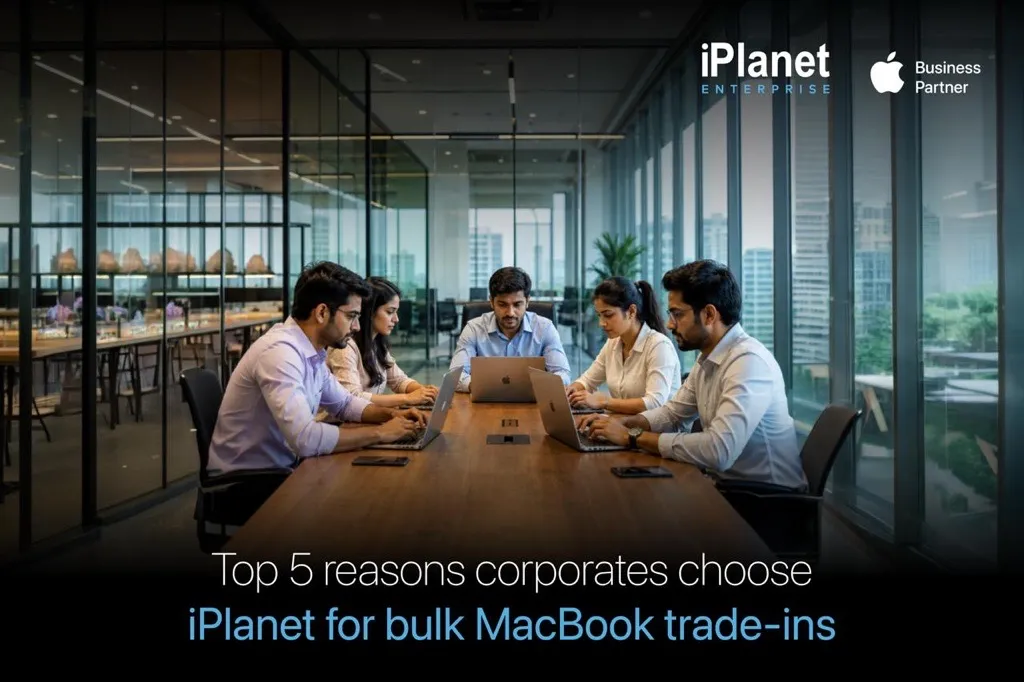
For enterprises looking to scale Apple ecosystems efficiently, iPlanet Business has emerged as a preferred partner for bulk MacBook trade-ins across India because the process is designed around continuity, lifecycle efficiency, and enterprise-scale execution rather than simple resale.
Here are five reasons why:
1.Enterprises Need Lifecycle Management
Managing a handful of devices might be easy, but managing hundreds across campuses, departments and locations is definitely not. And it is rarely about hardware alone.
The real task for most organisations is to reduce the disruption to a minimum while transitioning teams to upgraded systems. Laptops are not being looked at as one-time purchases by procurement teams, instead their entire lifecycle is being evaluated.
Bulk trade-ins involve checking factors like usage, deployment, maintenance, upgrades and eventual replacement. A fragmented trade-in procedure often creates downtime, delays approvals and leaves IT teams handling multiple vendors simultaneously, all of which seems unnecessary and avoidable with a structured process which makes upgrades less chaotic.
iPlanet Business approaches bulk MacBook trade-ins like an enterprise workflow, as part of a larger device strategy. The focus stays on a more structured transition process that reduces operational friction while helping organisations modernise their Apple ecosystem without disrupting everyday work.
2.Better Long-Term Value
One of the main reasons why investments in Apple hardware continue to grow in enterprise environments is its long-term value retention.
That becomes particularly relevant for businesses managing large fleets of machines over multiple upgraded cycles. MacBooks are typically known to maintain stronger resale and trade-in value compared to many traditional enterprise laptops and that alters the economics of large-scale upgrades.
Organisations can recover meaningful value from existing hardware and reinvest it into newer improvements instead of seeing device replacement as a sunk cost. A well-maintained MacBook ecosystem allows companies to refresh infrastructure more predictably and maintain consistency across teams.
This is also why conversations around Apple student discount India programs, Apple education pricing India students’ initiatives and Apple student discount MacBook value have become increasingly important beyond the education sector itself. Education institutions as well as enterprises are gradually recognising long-term operational value that Apple brings to the table, not simply its upfront cost.
When organisations get to stretch technology budgets further without compromising on quality or user experience, trade-ins become a strategic pro rather than an afterthought.
3.Secure Handling of Enterprise Devices
Every enterprise device contains operational history which makes device trade-ins largely about data responsibility than just about hardware.
As organisations scale, safe handling during transitions becomes increasingly important, especially across sectors like education, finance, consulting, healthcare and tech. A poorly handled upgrade can lead to security gaps, compliance risks and unnecessary operational exposure.
Companies are seen becoming extremely careful about asset handling, device accountability, data management workflows and standardised transition processes and rightfully so.
That is why corporations are increasingly prioritising partners who understand device handling at an enterprise scale. iPlanet Business works with organisations that need structured processes around device collection, evaluation and transition management. The result is a controlled and organised trade-in process that feels aligned with enterprise expectations. Because for modern organisations, trust is built more through operational consistency rather than marketing language.
4.Bulk Trade-Ins Require Operational Precision
As organisations grow, inconsistent hardware ecosystems often begin as a small inefficiency but they multiply quickly and create friction in the workflow.
A poorly coordinated hardware refresh can create uneven performance, compatibility issues, higher requirement for support and fragmented user experience, which is why companies now prioritise vendors who understand execution at an enterprise level rather than just retail sales.
Bulk trade-ins of MacBooks allow companies to standardise device environments in a more efficient way. For fast-growing teams, this creates advantages beyond IT. It makes onboarding easier, improves collaboration and prevents employees from spending too much time dealing with hardware limitations.
Many organisations are also looking at the broader operational benefit of maintaining a unified Apple ecosystem across departments and users instead of isolated transactions. iPlanet Business approaches trade-ins with that larger ecosystem strategy, which changes the nature of trade-in experience.
5.A Partner That Understands Apple Ecosystems
The strongest enterprise technology partnerships are the ones that go beyond procurement.
Hybrid work has changed the way companies think about workplace technology. Today, many businesses are actively decreasing fragmented environments because inconsistent systems often lead to support complexity, collaboration issues, software inconsistencies and higher long-term IT overhead. They look for partners who understand deployment planning, ecosystem integration, lifecycle management and long-term scalability.
That is exactly where specialised Apple enterprise experience makes a difference. Rather than painting trade-ins as isolated transactions, iPlanet Business integrates them into bigger conversations around workplace modernisation, education technology and device lifecycle optimisation.
Forward thinking enterprises, investing heavily in Apple environments, recognise this shift early and for them, the broader perspective matters.
For enterprises investing heavily in Apple environments, that broader perspective matters.
Why This Matters Now
The conversation around device management in organisations is evolving.
Companies are no longer evaluating devices solely as purchases. They are also thinking about long-term value recovery, operational efficiency, ecosystem consistency and scalability.
That changes how trade-ins are perceived.
A structured MacBook trade-in program supports all of those priorities at once. It is no longer just about recovering value from older devices. It is about enabling smoother transitions, reducing inefficiencies, and building a more future-ready workplace infrastructure.
As the Apple ecosystem continues to expand across businesses, having the right partner makes that transition significantly easier.
Ready to Upgrade Your Apple Device Ecosystem?
Whether you’re planning a large-scale hardware reset, managing an expanding workforce or exploring more efficient Apple lifecycle management, iPlanet Business helps organisations develop a structured trade-in strategy which can significantly reduce operational friction. Explore expert Apple solutions with iPlanet Business and discover how a structured Apple laptop trade-in business strategy can support smarter, more scalable technology transitions.
FAQs
Q1. What is the Apple laptop trade-in program offered by iPlanet Business?
iPlanet Business offers “Bulk MacBook Trade-in programs” specifically designed for larger companies and enterprises with a large number of devices for daily operations. iPlanet includes fair device valuations, certified data erasures, support in logistics and above everything else, credit can be applied towards newer Apple purchases. All of this because efficiency in tech is as important as the teams working in organisations.
Q2. Can businesses exchange old MacBooks for new Apple devices through iPlanet Business?
If you have a large fleet of devices that your enterprise is looking to upgrade, iPlanet Business offers “Bulk MacBook Trade-in programs”. These allow your organisation to apply trade-in valuation directly towards the upgraded devices that you finalise on. And the process? Managed end-to-end from device collection, data wipe all the way to credit application on new devices. As other customers put it, “It’s practical, simple and logical”. Especially if your organisation is in the midst of scaling and you need the ecosystem to keep up.